The Relationship Between Your Savings Account and Loan Interest Rates

Elena Rodriguez
Certified Financial Planner · Updated September 2026
Elena Rodriguez
Certified Financial Planner · Updated September 2026
Imagine it is early 2026, and you notice something curious in your banking app. The interest rate on your high-yield savings account has jumped from a meager 0.5% to a much more attractive 4.25%. At first glance, this feels like a victory for your net worth. However, when you go to shop for a personal loan to consolidate some old debt or finance a home improvement project, the quoted APRs look significantly higher than they did just six months ago. This is not a coincidence; it is the fundamental mechanics of the global economy at work. The connection between what banks pay you (your APY) and what they charge you (their APR) is deeply intertwined through central bank policy.
Understanding this relationship is vital for anyone looking to make informed financial decisions in 2026. Many borrowers mistakenly believe that high savings rates are an isolated benefit, but in reality, these rates often move in tandem with the cost of borrowing. When interest rates rise across the board, your money works harder in a savings account, but it also becomes more expensive to borrow that same money from a lender. For example, if you were looking at a 12% APR personal loan for $10,000 over 36 months, your monthly payment would be approximately #$332.15. In a low-rate environment, that might have been much lower, but in the current economic climate of 2026, those shifts are palpable.
This article is designed to move beyond basic definitions. We will explore why these rates fluctuate, how you can use this information to decide whether to save or pay down debt, and how to navigate the complexities of lending when the economy feels volatile. By the end of this guide, you should feel equipped to look at your bank statements not just as a list of numbers, but as a map of the broader economic landscape. Our goal is to provide you with the clarity needed to align your borrowing habits with your long-term financial health.
To understand why your savings and loans move together, you have to look at the Federal Reserve. In 2026, as inflation levels continue to stabilize, the Fed adjusts its benchmark interest rates to maintain economic balance. When the Fed raises the federal funds rate, it becomes more expensive for commercial banks to borrow money from one another overnight. To compensate for this increased cost of doing business, banks raise the interest rates they charge on loans and credit cards.
However, there is a flip side that benefits you: competition for deposits. When interest rates rise, consumers naturally seek out higher returns for their cash. To prevent customers from moving their money to high-yield accounts at other institutions, traditional banks are forced to raise the Annual Percentage Yield (APY) on their own savings products. This creates a dual effect where your 'cost of capital' goes up as a borrower, but your 'return on capital' also increases as a saver.
It is important to note that this relationship is not always perfectly linear. While the Fed sets the tone, individual lenders have significant autonomy. A bank might raise its savings rates quickly to attract liquidity but may be slower to lower loan rates even when the Fed cuts rates. This lag can create temporary windows of opportunity or frustration for borrowers trying to time the market.
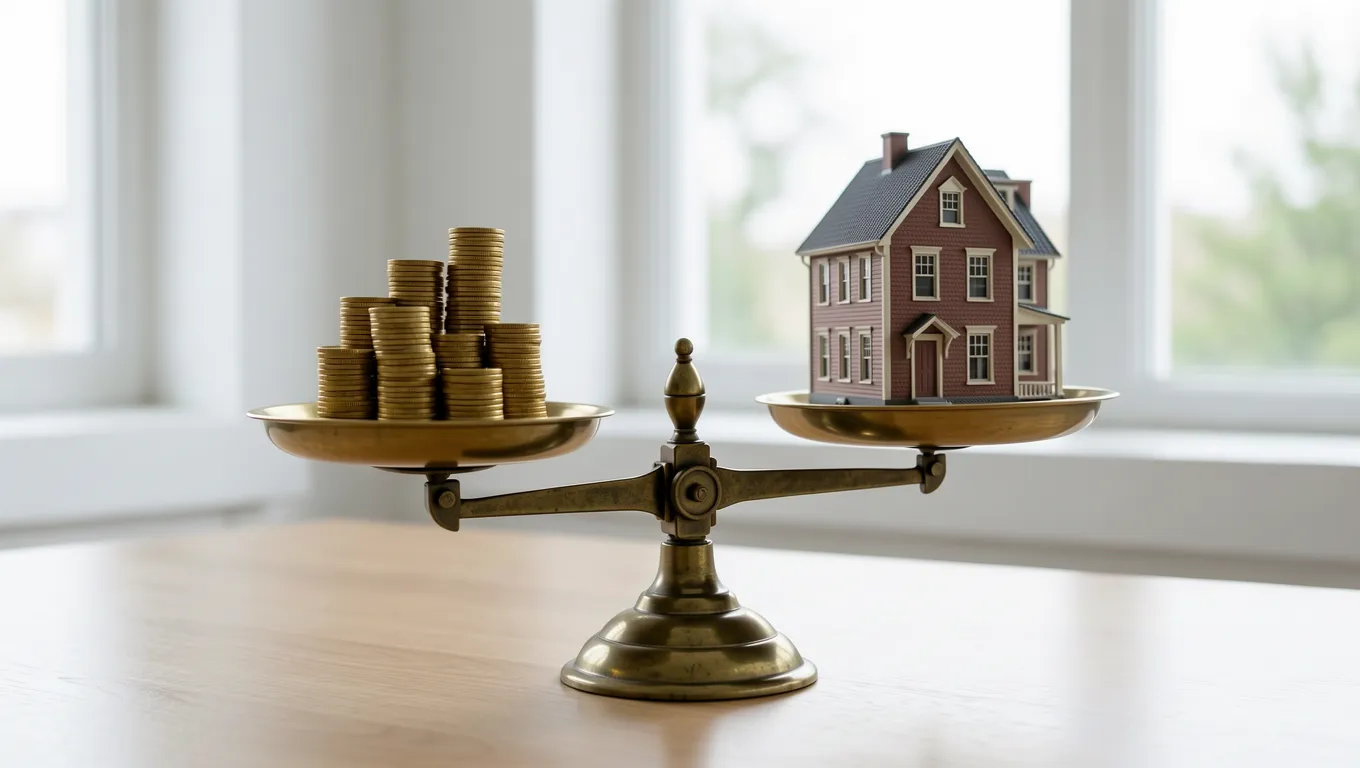
It is easy to confuse these terms, but the distinction is critical for your budget. APY (Annual Percentage Yield) represents the real rate of return on your savings, accounting for the effect of compounding interest over a year. On the other hand, APR (Annual Percentage Rate) is the yearly interest rate charged on a loan or credit card, excluding certain fees but including the base cost of borrowing.
In 2026, we see this relationship play out in real-time through 'interest rate spreads.' A bank's profit often comes from the difference between what they pay you for your savings and what they charge someone else for a loan. For instance, consider these two scenarios:
When you compare your savings to your debt, you are essentially looking at an 'interest rate spread.' This is the mathematical gap between what you earn and what you owe. For a person's net worth to grow, their investments (or savings) must ideally earn more than the interest they pay on any outstanding debt. In 2026, with rates being higher than in previous years, this spread has become much wider for many Americans.
Let us look at a concrete comparison of two common strategies. Imagine you have an extra $5,000 that you could either put into your savings account or use to pay down an existing high-interest personal loan.
Option 1: You place the $5,000 in a savings account with a 4.0% APY. After one year, you have earned approximately $200 in interest (before taxes).
Option 2: You use that $5,000 to pay down a loan that has an APR of 18%. By doing this, you are essentially 'earning' a guaranteed 18% return on that money because you have eliminated the interest that would have accrued on that $5,000.
As the numbers show, paying off high-interest debt is often the more effective financial move. Most financial experts suggest that if your loan APR is higher than your savings APY, you are effectively losing money every month by keeping the cash in a bank account instead of using it to reduce your debt.
Deciding between saving and paying down debt is one of the most common financial dilemmas. The best path depends on your specific circumstances, particularly your emergency fund status and the type of interest you are facing.
To navigate this, follow this decision framework:
Timing your borrowing can be just as important as deciding how much to borrow. In 2026, with interest rates remaining a central topic of economic discussion, many people are wondering: 'Should I wait for rates to drop?' The answer isn't a simple yes or no; it depends on the purpose of the loan.
If you are borrowing for an essential life need—such as medical expenses or necessary home repairs—the timing is less critical than finding the most competitive rate available. However, if you are looking at a large-scale consolidation or a major purchase, monitoring the trend is wise. If the Federal Reserve signals that they are entering a 'rate cutting cycle,' it may be beneficial to wait a few months for loan APRs to potentially decrease.
However, do not let the pursuit of a lower rate lead to procrastination that costs you more in the long run. For example, if you need to consolidate $12,000 in credit card debt with an APR of 24% into a personal loan with an APR of 12%, waiting six months for a potential drop to 11% might save you a small amount of interest, but the interest you continue to pay on that 24% debt in the meantime will likely far outweigh any savings from the lower rate. Always run the numbers on the total cost over the life of the loan before deciding to wait.
Even with the best intentions, many borrowers fall into predictable traps when navigating the relationship between savings and loans. One of the most dangerous mistakes is ignoring the impact of compounding interest on high-interest debt. Warning: A loan with a 20% APR compounds much faster than a savings account at 4% can ever grow; you cannot 'save' your way out of high-interest debt by simply being frugal.
Another common pitfall is the 'Liquidity Trap.' This occurs when an individual puts all their extra cash into paying down low-interest mortgage or student loan debt, leaving them with zero liquid savings. If an emergency arises in 2026—a car repair, a medical bill, or a sudden job change—they may be forced to use high-interest credit cards to cover the cost, effectively undoing all their hard work of paying down the original debt.
Finally, many people fail to account for the 'hidden' costs of borrowing. When comparing loans, always look at the total cost of the loan over its entire term, not just the monthly payment. A lower monthly payment might seem attractive, but if it comes from an extended term (e.g., 60 months instead of 36), you could end up paying thousands more in interest than a borrower with a higher monthly payment but a shorter timeline.
While the Federal Reserve and general market trends set the baseline for interest rates, your personal credit profile is the ultimate decider of what you will actually pay. In 2026, lenders remain highly selective. You could see two people with similar incomes apply for a $10,000 loan on the same day; one might be offered an APR of 9%, while the other is quoted 18%.
This discrepancy often comes down to credit scores and debt-to-income (DTI) ratios. Credit bureaus like Experian track your repayment history, and even small fluctuations can impact your ability to access lower rates. If you are planning a significant financial move—like taking out a personal loan for home renovations—it is wise to check your credit report months in advance.
Furthermore, lenders often use different risk models during periods of economic uncertainty. Even if the general trend of interest rates is downward, a lender might keep their specific APRs higher if they perceive an increase in default risks within your specific demographic or industry. This nuance means that you should always shop around and compare offers from multiple lenders to ensure you are getting a rate that truly reflects your personal creditworthiness rather than just the macro-economic average.